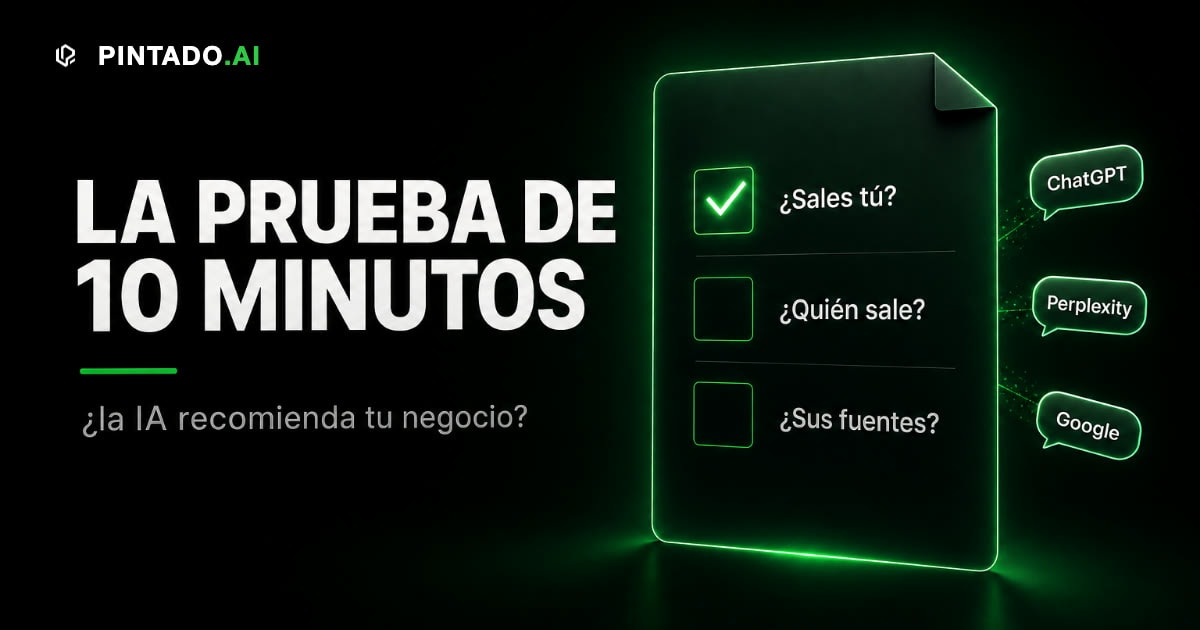
The 10-minute test: find out if AI recommends your business (or your competitor)
A simple way to find out today whether ChatGPT, Perplexity and Google AI Overviews recommend your business. Four steps, no paid tools.
TL;DR: Write 10 to 20 real buyer questions with your town included. Ask them in ChatGPT, in Perplexity and in Google with AI Overviews. Note three things per question: whether you show up, who shows up in your place, and where the AI pulls its sources from. Repeat the same set once a month and compare. That is your share of mentions, the real metric in this game. It takes about ten minutes and costs nothing.
You have never asked AI about your own business. Your customer has.
Every day someone in Bayamón, Caguas or Ponce opens ChatGPT and types "who installs solar panels near me." The AI answers with two or three names. One of those names could be yours or it could be your competitor's, and you have no way of knowing until you look.
The good news: looking is free and takes less time than answering an email. This post is the complete test, step by step, so you can run it today and know where you really stand.
How do you run the test?
Four steps. That's it.
1. Write 10 to 20 real buyer questions. Not marketing terms, not keywords. Questions the way your customer would say them out loud, with the town or area included. Examples:
- "Who installs solar panels in Bayamón"
- "How much does a dental cleaning cost in Caguas"
- "Best wedding planner near Dorado"
- "I need a trustworthy exterminator in the metro area"
The rule is simple: if you would not say it yourself while looking for that service, it does not go on the list. And if you have several service lines, cover each one with at least two questions.
2. Ask them in three places. ChatGPT, Perplexity and Google (look at the AI Overviews block above the results). The same question, word for word, in all three.
3. Note three things per question. A simple spreadsheet works. Three columns:
- Do you show up? Yes or no.
- Who shows up in your place? Exact names.
- Where does the AI pull its sources from when it shows them? Paste the links.
That third column is the most valuable one and the one almost nobody fills in. It is the map of whom the AI believes about your industry.
4. Repeat the same set once a month. Same questions, same three assistants, same spreadsheet. You compare month over month and see the movement. The percentage of questions where you appear is your share of mentions, or share of voice. That is the metric that matters here, not a ranking.
Why three assistants and not one?
Because each engine trusts different places. Profound analyzed 680 million citations and the pattern is clear: in ChatGPT, Wikipedia accounts for 47.9% of its top sources. In Perplexity, first place goes to Reddit with 46.7%. Google AI Overviews splits differently: Reddit 21.0% and YouTube 18.8%. These are shares within each engine's top sources, not of the whole web.
Translated to your business: if your reputation lives in only one kind of place, you will show up in one assistant and disappear in the others. Showing up in one does not mean showing up in the rest. That is why the test runs in three and why the results are recorded separately.
What does my result mean?
Three scenarios. Read them without alarm, because none of them is a verdict.
You do well (you appear in most questions, in more than one assistant). You are in a good position and you are the exception. Your job now is not to lose it: keep measuring monthly and watch whether someone new enters your category. A good result today does not hold still on its own.
You show up sometimes (you appear in some questions, or in only one assistant). This is the most common scenario and the most useful, because you already have a signal. Look at the pattern: do you show up for one service's questions and not another's? Do you show up in Perplexity but not in ChatGPT? That asymmetry tells you exactly where presence is missing.
You don't show up (you appear in none). It is not that you are being penalized. It is that the AI did not find enough references about you outside your own website, which in our view is the main lever in this game. The concrete steps to move it are in Your website is only half the game, and that is where you should go after this test.
An honest warning for all three cases: the same question can give you different answers each time. That is normal; it is how these models work. That is why there is no "#1 position" in AI and why a single run is not a verdict. The details of why are in Los 4 mitos del AEO que te están vendiendo (in Spanish).
How often should I repeat the test?
Once a month, with the same set of questions. Consistency is what turns the test into a metric; changing the questions every time turns it into an anecdote.
And here is the real advantage: according to Semrush, 45% of marketing leaders cannot measure their AI visibility. Almost nobody is looking at this. Whoever starts measuring early runs practically alone and sees the movement before the competition does.
If you want to formalize it without spending, Bing Webmaster Tools already reports when Microsoft's AI cites you, and it is free. Paid tools like Otterly, Profound or Peec start at around $29 a month according to their published pricing and make sense when you manage several brands or a lot of volume. For a local business, the manual monthly test is more than enough to start.
Your turn
The test tells you where you are. It is a diagnosis, not a treatment, and that is exactly its value: you stop guessing.
If you want the shortcut, the AEO Kit (in Spanish) is free and includes the bank of questions ready to copy and paste into ChatGPT, Claude and Perplexity, plus an actionable AEO checklist for when you have your results in hand.
And if you would rather we do it, request a free diagnosis. We run the test for you and tell you which lever to pull first.
The only thing that does not work is to keep not looking.
Sources
- Profound, analysis of 680 million citations by platform: https://www.tryprofound.com/blog/ai-platform-citation-patterns
- Semrush, AI Visibility Index 2026 (expanded edition): https://www.semrush.com/news/463141-semrush-releases-expanded-2026-ai-visibility-index/
Want to implement AI in your business?
Take our free diagnosis and find out how to save more than 15 hours a week with automation and artificial intelligence.
Free resources
Related articles
How much it costs to automate a business in Puerto Rico and how to tell if it pays off
The real investment ranges to automate a business in Puerto Rico: from $497 up to $7,500 a month, and the honest math to decide whether it pays off for you.
For AI to recommend your business, your website is only half the game
Your reputation outside your site decides whether ChatGPT recommends you. What the data says and what to do this week if your business is in Puerto Rico.
How to get ChatGPT to recommend your business in Puerto Rico (an honest 2026 guide)
An honest guide to getting ChatGPT and other AI assistants to recommend your business in Puerto Rico. What really works, what is myth, and your action plan.