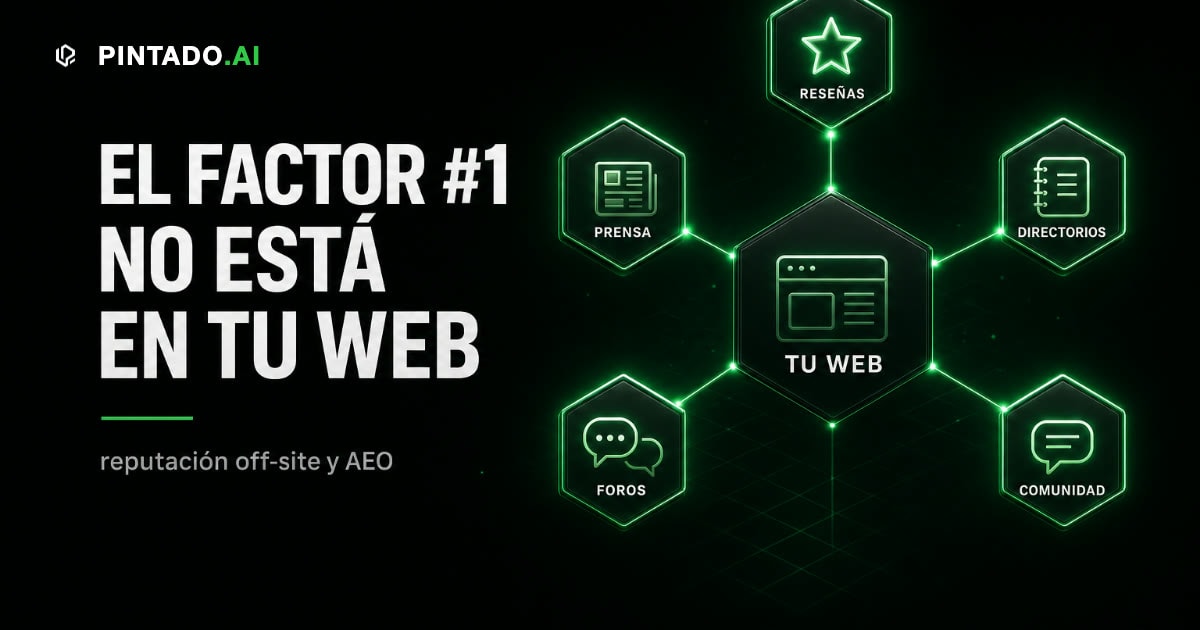
For AI to recommend your business, your website is only half the game
Your reputation outside your site decides whether ChatGPT recommends you. What the data says and what to do this week if your business is in Puerto Rico.
TL;DR: Our thesis: what most determines whether ChatGPT, Perplexity or Google recommends your business is not your website but your reputation outside it. According to Otterly's citations report (more than a million citations analyzed), 52.5% of AI citations come from community or third-party content, versus 47.5% from brand domains: more than half of what AI cites was not written by you. Your website still matters, but it is the secondary lever. The first one is what others say about you.
You invested in your website. It looks good, it loads fast, someone told you about "optimizing it for AI" and you even paid for that. And still, when a potential customer asks ChatGPT who does what you do in your town, the AI names three competitors and not you.
It is not that your website is bad. It is that you are playing on the wrong field.
Why does AI recommend your competitor and not you?
Because the model is not evaluating your site like a design judge. It is looking for confirmation, and our reading of the behavior we see is this: before naming a business, it leans toward the one that shows up consistently in more than one place.
Otterly's analysis of more than a million AI-generated citations reached an uncomfortable finding for the industry: 52.5% of citations come from community or third-party content, versus 47.5% from brand domains. And reference-type content, the kind that exists to be consulted, receives 3 to 5 times more citations than the rest.
Read it again. More than half of what AI cites does not come from the brand's site. These are not pages on your website: they are independent sources talking about you.
That is the trap almost nobody explains to you: your website is a single source, and on top of that it is yours. The AI knows it. A business that only exists on its own domain looks a lot like a business nobody has ever mentioned.
Where does each assistant look?
This is where it gets interesting, because not all assistants trust the same places. Profound analyzed 680 million citations and found very different patterns by engine:
- ChatGPT leans heavily on Wikipedia: it accounts for 47.9% of its top sources.
- Perplexity goes to real conversation: Reddit reaches 46.7% of its top sources.
- Google AI Overviews mixes: Reddit 21.0% and YouTube 18.8% of its top sources.
These are shares within each engine's top sources, not of the whole web.
Three engines, three completely different criteria for trust.
This explains why a single tactic is never enough. If your whole strategy lives on your blog, you are talking to only one kind of engine. The practical consequence is simple: it is not about choosing where to be, it is about being in several places at once so that whichever assistant it is finds something to confirm.
And the traffic? Here comes the honest part
If someone sold you AEO promising an avalanche of visits, I have to bring you back down to earth.
Cloudflare Radar's data is clear: AI refers a very small fraction of traffic compared with search engines. At the same time, those assistants read your page a lot. They consume it, process it, and almost never send the person back to you. They read a lot and refer little.
So what is all of this for?
It matters because the value of AEO today is not the click. It is the mention. It is that when someone asks "who can solve this for me?", your name comes up in the answer. The customer does not arrive through a link: they arrive because they heard your name from a source they trust and they look you up directly. It is reputation, not traffic. Whoever sells it to you as traffic either did not read the data or would rather you did not read it.
And yes, there is a lever inside your website: Princeton's research on generative engine optimization found that citing sources and concrete data can raise visibility by up to 40%. With one detail worth knowing: that improvement is mostly a redistribution. Sites that were around fifth position gain up to 115%, while those already at the top lose about 30%. It is the challenger's lever, not the leader's, and it is secondary. First you build the reputation outside; then you refine the content inside.
Why does almost nobody sell you this?
Because it is uncomfortable to bill for.
Changing things on your website is clean: there is a task list, the items get checked off, you are shown a nice report and the invoice gets paid. Reputation work outside your site is something else. It depends on a real customer writing a review, on a local journalist deciding to cover you, on an association including you in its directory. It is not under the full control of any agency, mine included.
And that is precisely why it works. If it were easy to manipulate, AI would have stopped trusting it already.
What do I do this week if my business is in Puerto Rico?
Five steps, in order, and they are our in-house recommendation, not a recipe taken from a study. Start with the first one even if you do nothing else.
1. A complete Google Business Profile, with real reviews. It is your number one local asset. Correct category, updated hours, exact address, listed services, recent photos. And ask for reviews from customers who actually bought from you, with their name and their experience. Do not buy reviews: fakes get detected and cost you more than they add.
2. The same name and the same information everywhere. Identical name, address and phone number on your website, on Google, on Bing Places, on your social profiles, in local directories and in your community groups. If in one place you are "Taller Ramírez Inc." and in another "Ramirez Auto", you are splitting your own evidence into two businesses the AI cannot connect.
3. Genuinely take part where your customer asks. Reddit, Facebook groups for your municipality, forums in your industry. Do not go in to drop your link: go in to answer the question someone asked, with judgment, for free. That is the material Perplexity and Google AI Overviews pick up.
4. Get third-party mentions. Local press, podcasts, chambers of commerce, professional associations in your industry. A story in a media outlet in your town weighs more than you think, because it is an independent source talking about you. That is where you build the half of the evidence that does not come from your own domain.
5. Measure mentions, not rankings. Once a month, ask ChatGPT, Perplexity and Google yourself what your ideal customer would ask. Note whether you show up, how many times and alongside whom. That is your share of voice, and it is the metric that applies in this game. The old idea of a "number one position" does not exist when a model writes the answer.
What I can promise you
None of this guarantees that AI will mention you. Citation is probabilistic: two people can ask the same question on the same day and get different answers. Anyone who sells you the number one spot in ChatGPT is selling you something they cannot deliver.
What we do know, with data on the table, is that more than half of what AI cites does not come from the brand's site. Hence our thesis, and it is ours: the lever that moves the needle most is the evidence that exists about your business outside your own domain. Work on it and you raise your odds for real. Ignore it and, however nice your website looks, you will stay invisible.
Start with your Google Business Profile. Today. It takes less than an hour.
Keep reading: if you have not seen it yet, Los 4 mitos del AEO que te están vendiendo (in Spanish) takes apart the most common promises before you pay for them. And if you want the full picture, there is the AEO guide for Puerto Rico 2026.
Want to know what AI says about your business today? Request a diagnosis and we will review it with data, not assumptions.
Sources
- Otterly, The AI Citations Report 2026 (analysis of more than a million AI citations): https://otterly.ai/blog/the-ai-citations-report-2026/
- Profound, AI Platform Citation Patterns (analysis of 680 million citations): https://www.tryprofound.com/blog/ai-platform-citation-patterns
- Cloudflare Radar, From Googlebot to GPTBot: who's crawling your site in 2025: https://blog.cloudflare.com/crawlers-click-ai-bots-training/
- Aggarwal et al., GEO: Generative Engine Optimization (Princeton): https://arxiv.org/abs/2311.09735
Want to implement AI in your business?
Take our free diagnosis and find out how to save more than 15 hours a week with automation and artificial intelligence.
Free resources
Related articles
How much it costs to automate a business in Puerto Rico and how to tell if it pays off
The real investment ranges to automate a business in Puerto Rico: from $497 up to $7,500 a month, and the honest math to decide whether it pays off for you.
The 10-minute test: find out if AI recommends your business (or your competitor)
A simple way to find out today whether ChatGPT, Perplexity and Google AI Overviews recommend your business. Four steps, no paid tools.
How to get ChatGPT to recommend your business in Puerto Rico (an honest 2026 guide)
An honest guide to getting ChatGPT and other AI assistants to recommend your business in Puerto Rico. What really works, what is myth, and your action plan.